La procédure
The hip is a ball-and-socket joint where the round head of the femur moves within the acetabulum, the socket that holds the ball in place. The hip may be prone to developing arthritis, where the smooth cartilage that lines the joint is eroded away.
Causes of arthritis range from age-related wear and tear (osteoarthritis) to previous hip injuries or inflammatory conditions (e.g. rheumatoid arthritis). Arthritis often causes pain and stiffness that can interfere with daily life.
Approches chirurgicales
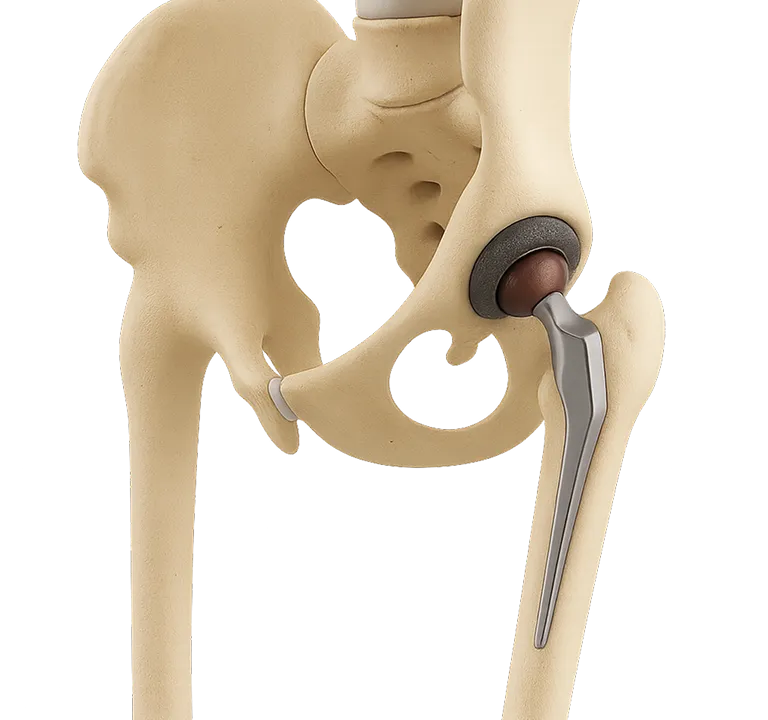
A total hip replacement, also called a total hip arthroplasty (THA), can relieve arthritic pain by addressing the root of the problem. It consists of removing the worn out hip and replacing it with a new prosthetic ball-and-socket metallic joint.
In a THA, the hip is generally accessed using one of three approaches; your surgeon will either perform the incision on the front (anterior), side (lateral), or back (posterior) of your hip. The approach will be chosen in accordance to your personal characteristics, the complexity of the reconstruction, and the surgeon's preference.
To access your hip joint, your surgeon will create an opening through the muscles surrounding it and open the joint capsule, where your hip joint lies. Once the joint is accessed, your surgeon will separate the round head of the femur and the acetabulum, adjust your hip socket and replace your hip with the prosthesis.
Risks and Complications of Hip Surgery
As with any surgery, a THA has its risks and complications, which include:
● New hip joint dislocation (1-3%)
● Periprosthetic fracture (5%)
● Prosthetic joint infection (1-2%)
● Venous thromboembolism (blood clot) (0.6-2.5%)
● Aseptic loosening (loosening of the prosthesis over time)
Additionally, some general minor risks associated with surgery and anesthesia in general include nausea, vomiting, headaches, sore throat, and urinary retention, whereas more serious general risks include blood clots and thus heart attack and stroke, allergic reactions, infection of the surgical wound, and pneumonia. Your surgeon will make sure to discuss the relevant risks with you prior to your surgery and take precautions to minimize the risk of any complications.
Une incision est pratiquée devant la hanche et l'articulation de la hanche est accessible en écartant les plans musculaires. Votre chirurgien peut restreindre votre amplitude de mouvement après l'opération pendant environ six semaines pendant que la capsule de la hanche cicatrisait.
l'une des approches les plus couramment utilisées, l'approche postérieure permet une excellente exposition de la hanche. Une incision est pratiquée sur le côté de la hanche et les muscles situés à l'arrière de la hanche sont séparés et écartés pour exposer l'articulation. Une fois les muscles réparés vers la fin de la chirurgie, assurant ainsi la stabilité, vous pouvez marcher sans restrictions. Dans certains cas, votre chirurgien peut recommander certaines restrictions de l'amplitude de mouvement pendant 6 semaines pendant que la capsule cicatrisera.
Également une approche couramment utilisée, l'approche latérale consiste à créer une incision sur le côté de la hanche et à fendre les muscles latéraux pour accéder à l'articulation. Cette approche est très stable en raison de l'endroit où la capsule est ouverte et, par conséquent, aucune restriction de mouvement n'est requise après l'opération.
À quoi s'attendre
Before the surgery, your doctor will perform a pre-surgical workup to make sure the surgical procedure is right for you. This entails having a discussion about your hip pain, examining your hip, and ordering the necessary tests, which may include X-ray or MRI imaging of your hip, pelvis, and/or spine, along with some blood tests, and potentially an electrocardiogram (ECG) and an analysis of your urine, depending on your state of health and clinical conditions. To minimize the risk of complications, you will receive antibiotics before your surgery to prevent infections and may receive anticoagulants (often called blood thinners) to avoid blood clots.
The procedure can be carried out under general anesthesia, regional anesthesia (e.g. spinal or epidural), or a combination of those modalities. The type of anesthesia is chosen by the anesthesiologist after a careful review of your personal medical profile and consideration of several factors, including your preferred choice.
After your surgery, our primary focus is on your comfort and recovery. To relieve pain, your doctor may employ a multimodal pain control strategy, which aims to tackle your postoperative pain in different, synergistic ways. This may include a combination of acetaminophen (or Tylenol), ibuprofen (or Advil), naproxen (e.g. Aleve), and, if needed, opioids (e.g. oxycodone). Additionally, a peripheral nerve block or lumbar epidural analgesia may be used to alleviate the pain; these two techniques block the pain by freezing the nerves that carry its signal.
Votre rétablissement
After an outpatient total hip arthroplasty, you will typically get to go home the same day, provided your orthopedic surgeon determines that your recovery is on the right track. Your postoperative care will include medications to manage your pain and prevent blood clots in the leg veins, along with starting physical therapy early with a physical therapist to help you recover quickly. In some cases however, your surgeon may restrict your hip movement for several weeks after the surgery while your hip capsule heals, depending on the surgical approach performed and your personal characteristics.
You will start doing some exercises to restore your hip's function and may use walking aids until you feel stable. Most patients return to activities like walking, swimming, and biking as they feel comfortable, but high-impact activities such as heavy lifting, intense sports, or manual labor should be avoided. Activity can slowly increase as muscle strength improves.
Long-term follow-up visits monitor your progress and confirm that the hip prosthesis and hip implant are functioning properly after joint replacement. Many patients report significant improvement in pain and mobility during the recovery process, with function significantly improving over time. Some patients feel close to pain free within three months to a year after surgery.
Relieve Your Hip Pain and Ask About Total Hip Replacement at Ortho MD Surgery
Living with ongoing damaged hip joints and hip pain can gradually affect daily movement and comfort. At
Ortho MD Surgery, the medical staff at our private clinic is focused on careful evaluation, thoughtful surgical planning, and attentive follow-up to support patients through hip replacement and recovery. Our goal is to help restore mobility and improve long-term joint function with modern orthopaedic techniques and experienced care that support your well being and quality of life. Learn more about our orthopaedic surgery procedures and
fees, or
contact us with any questions to get started today!
.svg)

.svg)
.svg)
.svg)
.svg)
